|
|
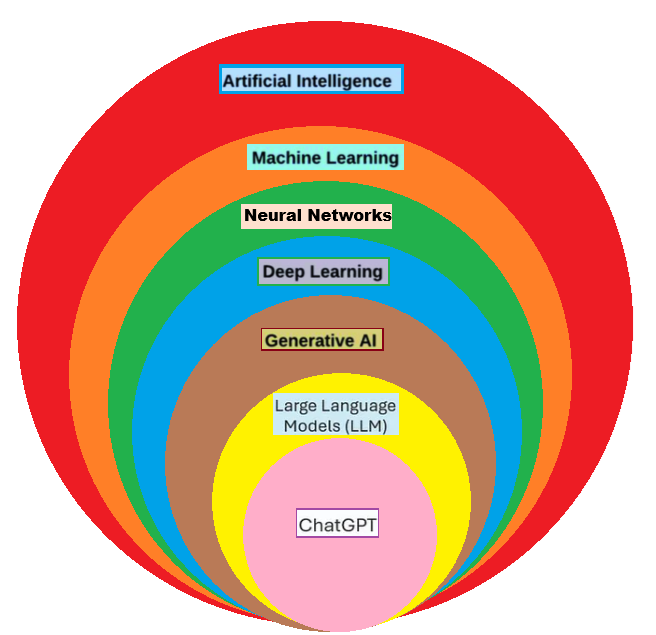
Generative artificial intelligence, or Generative AI, is a part of artificial intelligence that focuses on creating new content rather than just analyzing existing data.It uses advanced machine learning models to produce text, images, audio, videos, and even computer code. Unlike traditional AI systems that follow set rules or make predictions, Generative AI learns from large amounts of data to recognize patterns and then uses that knowledge to make original creations.
One of the main benefits of Generative AI is that it helps boost creativity and productivity. Writers can use it to write articles, students can use it to understand topics, designers can come up with new ideas, and programmers can write code faster. Businesses also use Generative AI to make personalized user experiences, improve customer service, and handle repetitive tasks.
The technology behind Generative AI relies on neural networks and other deep learning systems. These models are trained on huge amounts of data, allowing them to understand connections between words, images, sounds, and other kinds of information. This helps them create outputs that look and feel like they were made by humans.
As research continues, Generative AI is expected to become even more important in areas like business, healthcare, education, and entertainment. It is considered one of the most groundbreaking technologies today because it can create, invent, and help solve problems. In the future, Generative AI has the potential to change how people work, learn, and communicate by combining human creativity with machine intelligence.
Large Language Models (LLMs) are sophisticated artificial intelligence systems that have been trained on enormous volumes of text data in order to comprehend, produce, summarize, translate, and analyze human language. They can learn relationships between words, sentences, and larger contexts because they are constructed utilizing deep learning frameworks, mainly the Transformer Architecture. Without the need for task-specific programming, LLMs can execute a variety of natural language processing tasks by processing billions or even trillions of parameters.
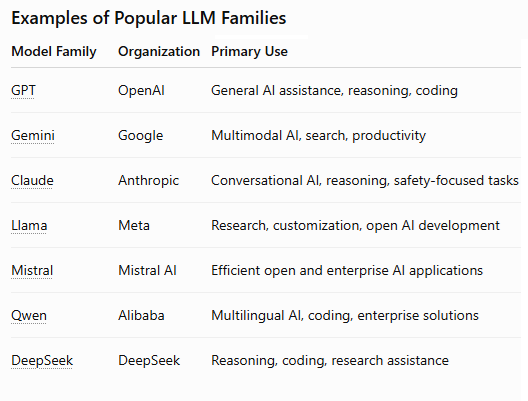
Chatbots, virtual assistants, content production, code generation, search engines, customer service, education, medical documentation, and business analytics are just a few of the applications that use LLMs. Models created by companies like OpenAI, Google DeepMind, Anthropic, and Meta AI are contemporary examples.
The architecture, training data, and fine-tuning techniques of LLMs determine their capabilities. While some models focus on coding, logic, multilingual communication, scientific research, or domain-specific tasks, others are made for general discourse. LLMs' accuracy, contextual awareness, and multimodal skills continue to grow as AI technology develops, allowing them to process not just text but also photos, audio, and video. Despite their advantages, LLMs can nevertheless produce inaccurate data, necessitating human supervision in crucial applications.
An open-source framework called LangChain was created to make it easier to create applications that use Large Language Models (LLMs). It offers an organized method for integrating language models with databases, APIs, external data sources, and business processes. LangChain allows developers to create sophisticated systems that can reason, retrieve information, and carry out multi-step activities, as opposed to employing an LLM as a stand-alone text generator.
The modular architecture of LangChain is one of its main advantages. To construct unique AI solutions, developers can combine elements like chains, agents, tools, memory modules, prompts, and document loaders. A customer service chatbot, for instance, can utilize LangChain to obtain corporate policies from a knowledge base, recall past exchanges, and produce context-aware responses.
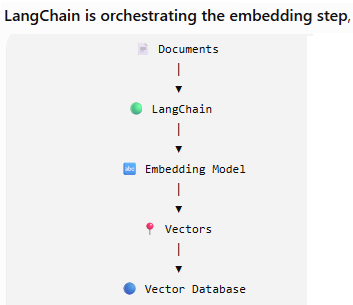
Additionally, LangChain facilitates integration with various APIs, cloud platforms, search engines, and vector databases. Instead of depending only on the data used for model training, this enables applications to obtain real-time information. AI assistants, enterprise search systems, document analysis platforms, and automated workflow solutions all make extensive use of this framework.
LangChain acts as a link between language models and useful commercial applications as more companies embrace generative AI. It is a well-liked option for creating scalable and production-ready AI systems because of its adaptability, extensibility, and support for numerous LLM suppliers.
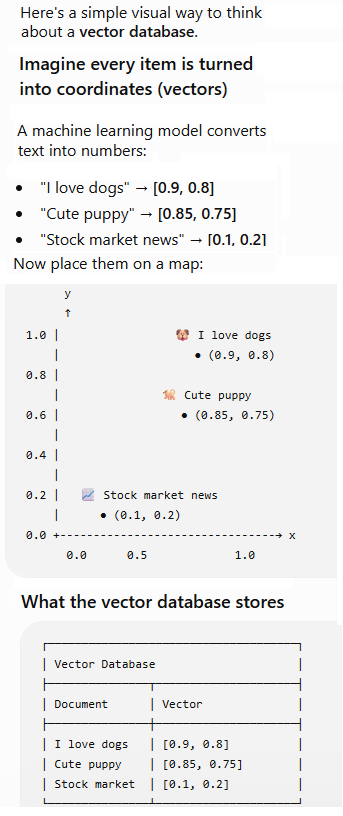
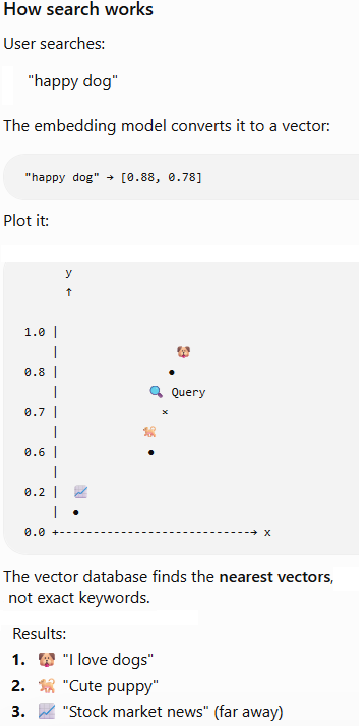
High-dimensional vector embeddings produced by machine learning models can be stored, indexed, and searched using a specialized database called a vector database. Vector databases find information based on semantic similarity, in contrast to typical databases that use keywords or structured fields to find exact matches. They are especially useful in contemporary AI and machine learning applications because of this feature.
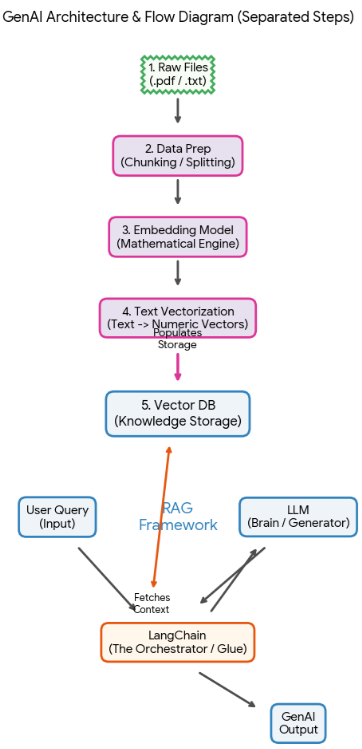
Embedding models convert text, images, music, and other inputs into numerical vectors that represent its relationships and meaning. These embeddings are kept in a vector database, which employs similarity search techniques to locate vectors that are most similar to a query vector. Because of this, users are able to obtain information based on meaning rather than precise phrasing.
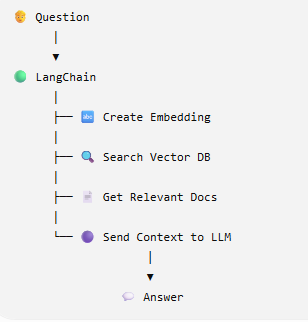
Retrieval-Augmented Generation (RAG) techniques rely heavily on vector databases. To find the most pertinent documents, a user's query is transformed into an embedding and compared to stored embeddings. The language model then receives these texts as context.
Semantic search, recommendation systems, document retrieval, picture similarity search, fraud detection, and personalized content distribution are examples of common use cases. Because vector databases are fast and scalable, they can effectively manage millions or even billions of embeddings. Vector databases are now a crucial infrastructure element for intelligent search and information retrieval systems as AI applications depend more and more on semantic comprehension.
An AI architecture called Retrieval-Augmented Generation (RAG) combines the text-generation power of Large Language Models with information retrieval methods. Conventional language models produce answers based only on information acquired during training, which could become out-of-date or insufficient. By obtaining pertinent data from outside knowledge sources before to producing a response, RAG overcomes this constraint.
There are usually two steps in the RAG process. In order to locate information pertinent to the user's query, a retrieval system first searches a knowledge repository, such as documents, databases, webpages, or vector stores. Second, the language model receives the retrieved content as context and uses it to build a response.
This strategy has a number of benefits. Without retraining the model, it increases factual accuracy, decreases hallucinations, and makes current knowledge accessible. In order to enable AI systems to respond to queries based on internal business data, organizations can also leverage secret or confidential documents as knowledge sources.
Enterprise search, customer service, research assistants, legal document analysis, healthcare information systems, and educational platforms all make extensive use of RAG. RAG produces knowledgable and flexible AI applications by fusing retrieval and generation. RAG has developed into a fundamental framework for creating reliable and scalable generative AI solutions as the amount of digital data keeps increasing.