|
PythonPlaza -
Python & AI
|
Supervised Machine Learning Algorithms
Polynomial Regression
Polynomial Regression is a type of linear regression where the connection between the input variable (x) and the output variable (y) is shown using a polynomial equation of degree n. It works well when the data shows a curved pattern, letting the model create a curve that fits the data points closely.
Polynomial regression is used when the connection between the input and output isn't straight or linear. Instead of drawing a straight line like in linear regression, it uses a curved line made from a polynomial equation to better match shape of the data better.
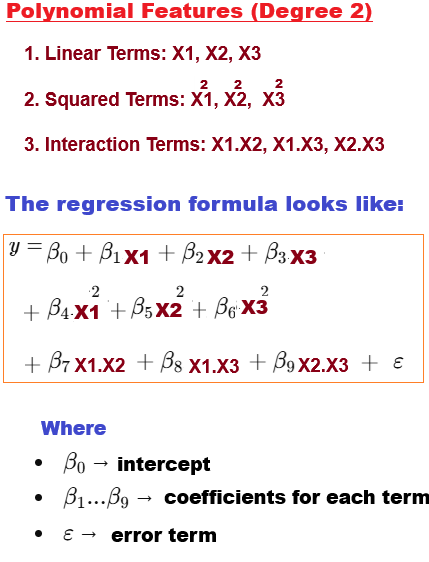 USE CASE 1: Using Polynomial Regression with scikit-learn, predict the product price. The Production cost, Advertising spend, and Demand level are the independent variables.
import pandas as pd
import pandas as pd
from sklearn.model_selection import train_test_split
from sklearn.preprocessing import PolynomialFeatures
from sklearn.linear_model import LinearRegression
from sklearn.metrics import mean_squared_error, r2_score

# -----------------------------------
# 1. Load data from Excel
# -----------------------------------
data = pd.read_excel("product_data.xlsx")

print("Dataset Preview:")
print(data.head())

# -----------------------------------
# 2. Define features and target
# -----------------------------------
X = data[['Production_Cost', 'Advertising_Spend', 'Demand_Level']]
y = data['Product_Price']

# -----------------------------------
# 3. Split into training and testing
# -----------------------------------
X_train, X_test, y_train, y_test = train_test_split(
    X, y, test_size=0.25, random_state=42
)

## What is random_state?

#train_test_split randomly shuffles the dataset before splitting.
#Without random_state:
#Each run → different split
#Model performance changes slightly
#With random_state=42:
#Same rows go to train/test every time
#Results are reproducible

poly = PolynomialFeatures(degree=2)
X_train_poly = poly.fit_transform(X_train)
X_test_poly = poly.transform(X_test)

# -----------------------------------
# 4. Train the  Model
# -----------------------------------
model = LinearRegression()
model.fit(X_train_poly, y_train)


# -----------------------------------
# 5. Evaluate the model
# -----------------------------------
y_pred = model.predict(X_test_poly)

mse = mean_squared_error(y_test, y_pred)
r2 = r2_score(y_test, y_pred)

print("Mean Squared Error:", mse)
print("R2 Score:", r2)

# -----------------------------------
# 6. Predict price for a new product
# -----------------------------------
new_product = pd.DataFrame({
    'Production_Cost': [68],
    'Advertising_Spend': [13],
    'Demand_Level': [37]
})

predicted_price = model.predict(new_product)

print("\nPredicted Product Price:", predicted_price[0])
USE CASE 2: Using Polynomial Regression with scikit-learn to predict the Student Grade. The 'Hours_Studied, 'Attendance_%', 'Previous_Score' are the independent variables.
import pandas as pd
from sklearn.model_selection import train_test_split
from sklearn.preprocessing import PolynomialFeatures
from sklearn.linear_model import LinearRegression
from sklearn.metrics import mean_squared_error, r2_score

# -----------------------------------
# 1. Load data from Excel
# -----------------------------------
#sample data can be exported to
#excel from the URL
# https://pythonPlaza.com/linear_school_grade_data.html

data = pd.read_excel("student_data.xlsx")

print("Dataset Preview:")
print(data.head())

# -----------------------------------
# 2. Define features and target
# -----------------------------------
X = data[['Hours_Studied', 'Attendance_%', 'Previous_Score']]
y = data['Final_Grade']

# -----------------------------------
# 3. Split into training and testing
# -----------------------------------
X_train, X_test, y_train, y_test = train_test_split(
    X, y, test_size=0.25, random_state=42
)

## What is random_state?

#train_test_split randomly shuffles the dataset before splitting.
#Without random_state:
#Each run → different split
#Model performance changes slightly
#With random_state=42:
#Same rows go to train/test every time
#Results are reproducible

poly = PolynomialFeatures(degree=2)
X_train_poly = poly.fit_transform(X_train)
X_test_poly = poly.transform(X_test)


# -----------------------------------
# 4. Train the  Model
# -----------------------------------
model = LinearRegression()
model.fit(X_train_poly, y_train)


# -----------------------------------
# 5. Evaluate the model
# -----------------------------------
y_pred = model.predict(X_test_poly)

mse = mean_squared_error(y_test, y_pred)
r2 = r2_score(y_test, y_pred)

print("Mean Squared Error:", mse)
print("R2 Score:", r2)

Example: Predict a new student’s grade
# New student: [hours_studied, attendance %, previous_score]
new_student = np.array([[6, 85, 78]])

predicted_grade = model.predict(new_student)
print("Predicted final grade:", predicted_grade[0])
USE CASE 3: Using Polynomial Regression with scikit-learn to predict the Profit Optimization. The Price (P), Advertising (A), Units Sold (Q) are the independent variables, and Profit is the dependent variable.
import pandas as pd
from sklearn.model_selection import train_test_split
from sklearn.preprocessing import PolynomialFeatures
from sklearn.linear_model import LinearRegression
from sklearn.metrics import mean_squared_error, r2_score

# -----------------------------------
# 1. Load data from Excel
# -----------------------------------
#sample data can be exported to
#excel from the URL


  Get the Profit Optimization data in Excel


data = pd.read_excel("profit_optimization.xlsx")

print("Dataset Preview:")
print(data.head())

# -----------------------------------
# 2. Define features and target  Price (P)
# -----------------------------------
X = data[['Price', 'Advertising', 'Units_Sold']]
y = data['Profit']

# -----------------------------------
# 3. Split into training and testing
# -----------------------------------
X_train, X_test, y_train, y_test = train_test_split(
    X, y, test_size=0.25, random_state=42
)

## What is random_state?

#train_test_split randomly shuffles the dataset before splitting.
#Without random_state:
#Each run → different split
#Model performance changes slightly
#With random_state=42:
#Same rows go to train/test every time
#Results are reproducible

poly = PolynomialFeatures(degree=2)
X_train_poly = poly.fit_transform(X_train)
X_test_poly = poly.transform(X_test)

# -----------------------------------
# 4. Train the  Model
# -----------------------------------
model = LinearRegression()
model.fit(X_train_poly, y_train)


# -----------------------------------
# 5. Evaluate the model
# -----------------------------------
y_pred = model.predict(X_test_poly)

mse = mean_squared_error(y_test, y_pred)
r2 = r2_score(y_test, y_pred)

print("Mean Squared Error:", mse)
print("R2 Score:", r2)

#Predict profit for a new business strategy
# Example: Price = 15, Advertising = 165, Units Sold = 460
new_strategy = np.array([[15, 165, 460]])

predicted_profit = model.predict(new_strategy)
print("Predicted profit:", predicted_profit[0])
USE CASE 4: Using Polynomial Regression with scikit-learn to predict the Patient Response. The Dosage (mg), Age (yrs), Weight (lbs) are the independent variables, and Patient Response is the dependent variable.
import pandas as pd
from sklearn.model_selection import train_test_split
from sklearn.preprocessing import PolynomialFeatures
from sklearn.linear_model import LinearRegression
from sklearn.metrics import mean_squared_error, r2_score

# -----------------------------------
# 1. Load data from Excel
# -----------------------------------
#sample data can be exported to
#excel from the URL


  Get the Patient Response Data in Excel


data = pd.read_excel("patient_dosage_response.xlsx")

print("Dataset Preview:")
print(data.head())

# -----------------------------------
# 2. Define features and target  Price (P)
# -----------------------------------
X = data[['Dosage', 'Age', 'Weight']]
y = data['Patient_Response']

# -----------------------------------
# 3. Split into training and testing
# -----------------------------------
X_train, X_test, y_train, y_test = train_test_split(
    X, y, test_size=0.25, random_state=42
)

## What is random_state?

#train_test_split randomly shuffles the dataset before splitting.
#Without random_state:
#Each run → different split
#Model performance changes slightly
#With random_state=42:
#Same rows go to train/test every time
#Results are reproducible

poly = PolynomialFeatures(degree=2)
X_train_poly = poly.fit_transform(X_train)
X_test_poly = poly.transform(X_test)

# -----------------------------------
# 4. Train the  Model
# -----------------------------------
model = LinearRegression()
model.fit(X_train_poly, y_train)


# -----------------------------------
# 5. Evaluate the model
# -----------------------------------
y_pred = model.predict(X_test_poly)

mse = mean_squared_error(y_test, y_pred)
r2 = r2_score(y_test, y_pred)

print("Mean Squared Error:", mse)
print("R2 Score:", r2)

Predict response for a new patient
# New patient: Dosage=72mg, Age=36yrs, Weight=172lbs
new_patient = np.array([[72, 36, 172]])

predicted_response = model.predict(new_patient)
print("Predicted patient response:", predicted_response[0])
About Us | Contact Us | Sitemap | Privacy Policy